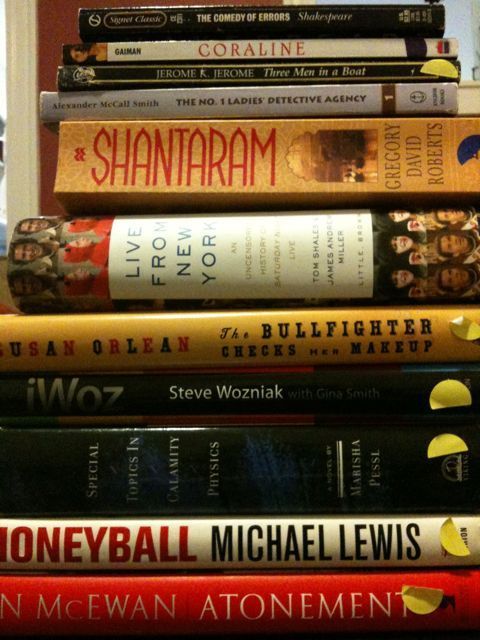
What I got for $6.50 at our library book sale, or why I love my library.
Author: Devanshu Mehta
Six Word Stories
Friday evening, Roger Ebert started a trend on Twitter— #6wordstory. People started tweeting stories in six words; mostly lame, mostly not even stories.
Here are the ones I contributed. I’m quite proud of a couple (guess or click on the ? to find out which story I’m summarizing):
Veni vidi vici. Et tu, Brutus? ?
Yudhishthira rolled the dice. Everyone lost. ?
Billy Pilgrim became unstuck in time. ?
This one really isn’t a story:
6? That’s not enough to finish…
And this one isn’t original:
Pinch of salt rocked an empire.
Any contributions?
To Live as a Monster or Die as a Good Man
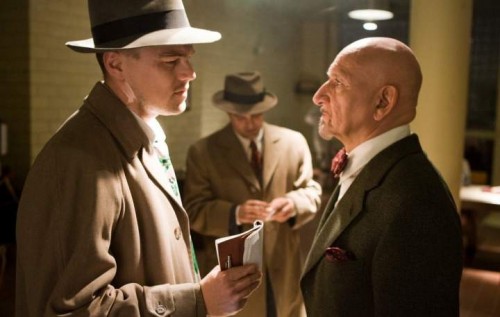
Martin Scorsese’s Shutter Island is an extraordinary film. It is Hitchcock, classic noir, Dr. Moreau all at once. But does it cheat?
It’s a question that comes up many times in movies that provide an elaborate twist at the end that makes you rethink the entire movie. Like, say, The Sixth Sense (does not cheat), The Usual Suspects (one big cheat), The Sting (cheats).
What I mean by cheating is this– were there scenes in the movie which were solely meant to mislead the viewer? Or did they serve a purpose in the plot?
Of course, all movies cheat through editing; through what they do not show. But what they do show shouldn’t be a lie.
Well, I’ve only watched it once, but I believe Shutter Island does not cheat.
Tread lightly from this point forward, for here there be dragons! Spoilers about the film may be revealed. Turn back, all ye who wish to remain unsullied. Continue reading
World War Z

World War Z is a book written by Max Brooks, on behalf of the United Nations. It is a series of interviews, presented as an oral history of the zombie apocalypse. No, the zombie apocalypse has not actually happened.
The book tells of an alternate present, where an outbreak of rising dead turns in to a world-wide epidemic. The story doesn’t unfold as classical horror, but as a look at geopolitical implications, military strategy, and individual survival instincts in the face of an unprecedented, global threat.
It deals with the big questions– wouldn’t Israel deal with such a threat in a fundamentally different way than say South Africa or Russia, because of their history? How would our military machinery work against an enemy who does not work under the traditional parameters– has no emotions, no family, no expenses, and can only be downed by decapitation? And for every one soldier you lose, they gain one.
As I said, the story is told as a series of interviews, a few years after the war is over– an interview of a doctor who saw the first cases in China, an Israeli intelligence agent who was among the first to take the threat seriously, of US military personnel, a South African politician, and of so many individuals from across the globe. While the climax is told from an American perspective, this is a global story and that is what really makes it special– the plausible military, social and political implications.
∞
The audiobook makes this book even better. Here’s part of the cast: Alan Alda, Carl Reiner, Rob Reiner, John Turturro, Mark Hamill, Henry Rollins, and Jürgen Prochnow. Since each chapter is an interview with a different person, this format works really well.
Funny People

 Considering the talent involved, this should have been a much better movie– Adam Sandler, Seth Rogen (Knocked Up), Jonah Hill (Superbad), Eric Bana (Hulk, Black Hawk Down), Jason Schwartzman (Rushmore), Aziz Ansari (Parks & Recreation), Aubrey Plaza (Parks & Recreation). Written and directed by Judd Apatow. This should have been so much better.
It’s the story of a comic (Sandler) who learns that he may not have very long to live. He takes a struggling comedian (Rogen) under his wing. This is Sandler giving his second-best performance of all time (the best is here) and I really wanted to like it. The first hour was fantastic, but it just falls apart after that.
 Things
You must be logged in to post a comment.